Let’s be honest.
When most people search for free project management templates, they are not doing it because they love collecting documents like digital souvenirs. They are usually trying to solve a real problem.
Maybe money is tight. Maybe they are between jobs. Maybe they are new to project management and trying to get their footing. Maybe they are already managing projects and want to look more polished, more prepared, and more confident in front of their boss.
And listen, I get it. Sometimes you do not need a fancy, high-priced enterprise system. You just need a solid template that helps you stop staring at a blank page like it personally offended you.
But here is the real question: Where can you find project management templates that are not just free, but actually useful? Because free is nice. Useful is better.
Why People Look for Free Project Management Templates
Most people are not looking for free templates because they are cheap. They are looking because they are trying to be resourceful. There is a clear difference.
A new project manager may not have a budget for tools yet. Someone preparing for a new role may need examples to study to understand the industry standard. A current project manager may want to improve how they communicate, track work, or report progress without spending hours building every single spreadsheet from scratch.
Good templates can help you:
- Save time.
- Stay organized.
- Communicate more clearly.
- Look more professional.
- Avoid missing important details.
- Give your team structure.
- Impress leadership without tap dancing through chaos.
A good template is not just a document; it is a thinking tool. It helps you ask the right questions before the project has a chance to run off into the bushes.
The Best Free Project Management Templates to Look For First
If you are just getting started, do not download 47 templates and then wonder why your desktop looks like a project management garage sale. Start with the essentials. These are the templates I believe every project manager should have in their toolkit first.
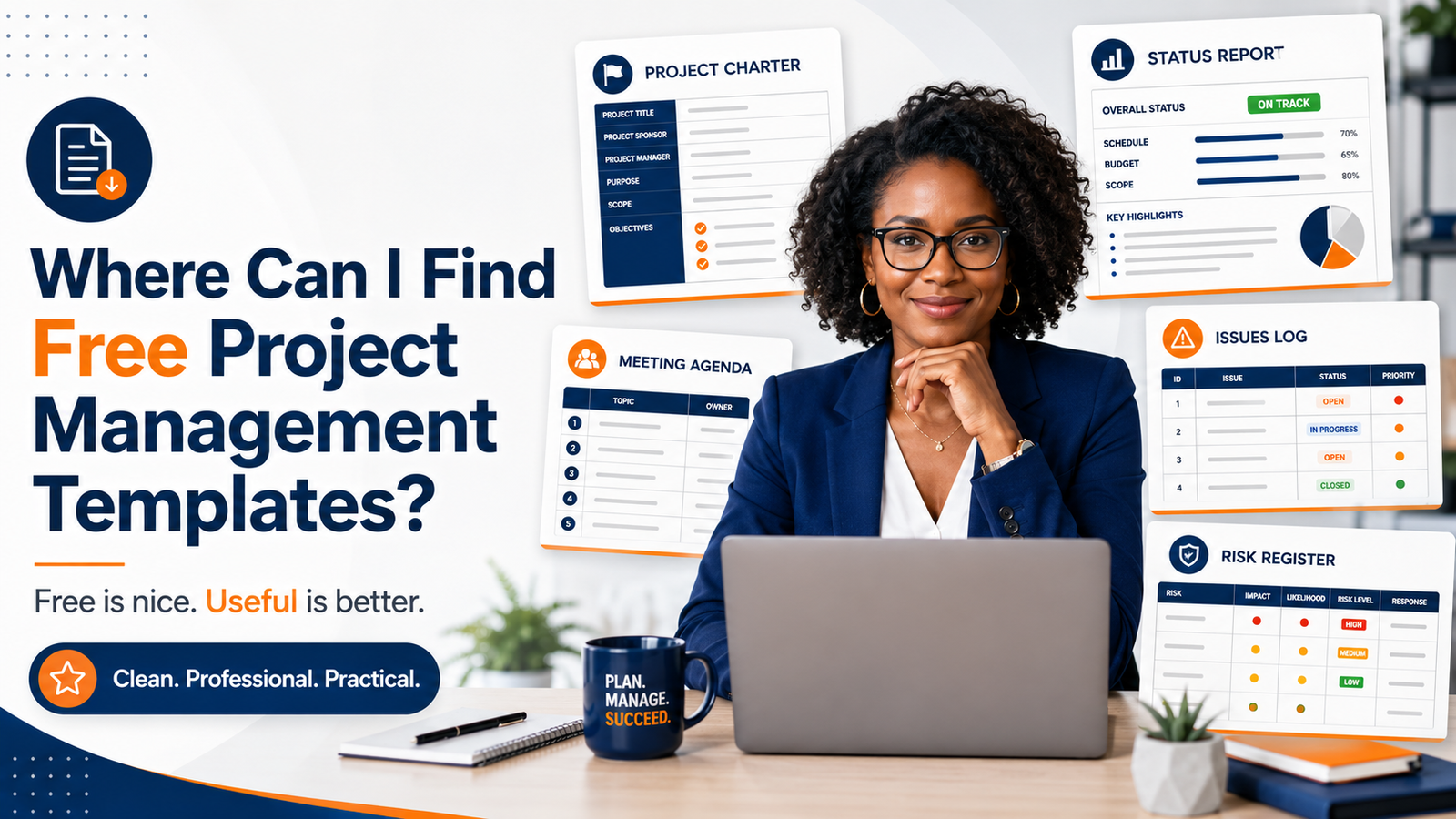
1. Project Charter Template
The project charter is one of the most important project documents because it captures the big picture. It is the document that officially authorizes the project and gives the manager the power to use organizational resources.
It usually includes things like:
- Project purpose.
- Objectives.
- Scope.
- Key stakeholders.
- High-level timeline.
- Major risks.
- Roles and responsibilities.
- Approval information.
But here is the trick: A project charter should not feel like a novel. It should be clear, concise, and easy to read. Leadership should be able to glance at it and understand what the project is about, why it matters, and who is responsible for what. A messy project charter can confuse people before the project even starts. And that is not the kind of grand opening we want.

2. Meeting Agenda Template
A consistent project meeting agenda is one of those simple tools that quietly makes you look like you have your whole life together, even if you do not.
A good meeting agenda helps people know:
- Why they are meeting.
- What will be discussed.
- Who needs to provide updates.
- What decisions need to be made.
- What actions need follow-up.
People love being able to glance at an agenda and quickly understand how to prepare. No one wants to walk into a meeting and feel like they accidentally joined the wrong Zoom room.
3. Project Status Report Template
A status report helps you communicate progress in a clean, consistent way. This is especially important when leadership wants updates but does not want to read a twelve-page report with dramatic plot twists.
A strong status report should show:
- Overall project health (Red/Amber/Green status).
- Schedule status.
- Budget status.
- Key accomplishments.
- Upcoming work.
- Risks and Issues.
- Decisions needed.
The best status reports are simple, visual, and direct. They answer the big question everyone is thinking: Are we okay, or should somebody be worried?
4. Issues Log Template
An issues log helps you track problems that need immediate attention. This is different from a risk. A risk might happen; an issue is already knocking on your door with muddy shoes.
Your issues log should track:
- The issue description.
- Who owns it.
- Priority level.
- Current status.
- Due date for resolution.
- Resolution notes.
This helps you stay on top of problems instead of relying on memory, sticky notes, or that one heroic person who “remembers everything.” Spoiler alert: eventually, that person goes on vacation.

5. Risk Management Template
A risk management template helps you think ahead. It helps you identify what could go wrong, how serious it might be, and what you plan to do about it.
A good risk template usually includes:
- Risk description.
- Probability of occurrence.
- Impact on the project.
- Risk level (Low/Medium/High).
- Response plan (Mitigate, Avoid, Transfer, or Accept).
- Owner.
Risk management is not about being negative; it is about being prepared. There is a big difference between “I am worried” and “I have a plan.”
Where Can You Find Free Project Management Templates?
You can find free project management templates in several places across the web. But be careful. Not all free templates are created with the same level of care. Some are too generic, some are poorly formatted, and some look like they were assembled in a hurry during someone’s lunch break. You want your templates to feel like they belong together: clean, professional, and consistent.
What to Look for Before You Trust a Free Template
Before you download and deploy a free template, check for these three signs of quality:
- Does it include instructions? A good template should come with a README file or a quick guide. If you open the document and feel like you need a detective to find the “Total” column, move on.
- Can you preview it? You should not have to open a mystery box. A thumbnail or screenshot helps you see the design before you commit.
- Is it easy to customize? You should be able to add your logo, change colors, and adjust sections to fit your organization.
One of the biggest mistakes people make is using a template exactly as-is. They do not change the branding or adjust the format. The document may be technically useful, but it still feels “borrowed.” Borrowed does not always build confidence in your leadership.

Are Free Project Management Templates Worth It?
Yes, free templates can be worth it, but only if they are clear, useful, and easy to customize. They are great when you are learning or working with zero budget.
But here is my honest opinion: You often get what you pay for.
Many free templates are free because they are generic. They might not be professionally structured or flow well. They often lack the “thinking” behind the document. The better question is not “Is it free?” but “Will this template help me look prepared, confident, and capable?”
If the answer is yes, great. If the answer is no, a small investment in a professional set might save you hours of frustration and a lot of embarrassment in front of your boss.
My Recommendation: PMTeacher.com
If you are tired of the “flea market collection” of random downloads, I recommend looking at a more cohesive system.
At PMTeacher.com, I created templates specifically for small to medium-sized projects. They are not free, but they are very affordable. They include everything from the project charter to the risk management log, and they all share a consistent, professional look. When your documents look like they belong together, it tells your team and leadership that you are organized and taking the work seriously.
Consistency transfers thinking. It gives you a path to follow so you can focus on the work, not the formatting.
Final Thoughts
Finding free templates is easy; finding helpful ones is the challenge. If you are just starting out, grab the freebies and start practicing. But when you are ready to move from “I downloaded this” to “I know exactly what I am doing,” invest in a system that supports you.
Because free is nice. But useful? Useful is where the magic happens.
If you need more than just templates and want to truly master these skills, consider checking out our training options or consulting services to get your projects on the right track.
Core Project Management Essentials
5757 W. Century Blvd, 7th Floor, Suite 52A
Los Angeles, CA 90045
(877) 633-2763
www.corepmessentials.com
www.pmteacher.com (Courses, Bootcamp & Templates)
www.pmteacher.com/free-mini-exam/