

The short answer? Traditional project management is not entirely dead, but it is rapidly becoming obsolete for modern organizations operating in unpredictable, fast-moving business environments.
The reality is more nuanced than a simple yes or no. Traditional approaches still have limited applications, but they require significant evolution to remain relevant. If your organization is still relying on manual planning through Excel spreadsheets, paper-based documentation, email coordination, and rigid waterfall structures, you are creating substantial organizational challenges.
Research shows that 65 percent of projects are plagued by wasted resources and unrealized benefits, largely due to outdated technology and methodologies. These legacy approaches struggle with flexibility, as any change to project requirements necessitates tedious manual updates that consume time, introduce errors, and create team misalignment.
The Problem with Traditional Methods
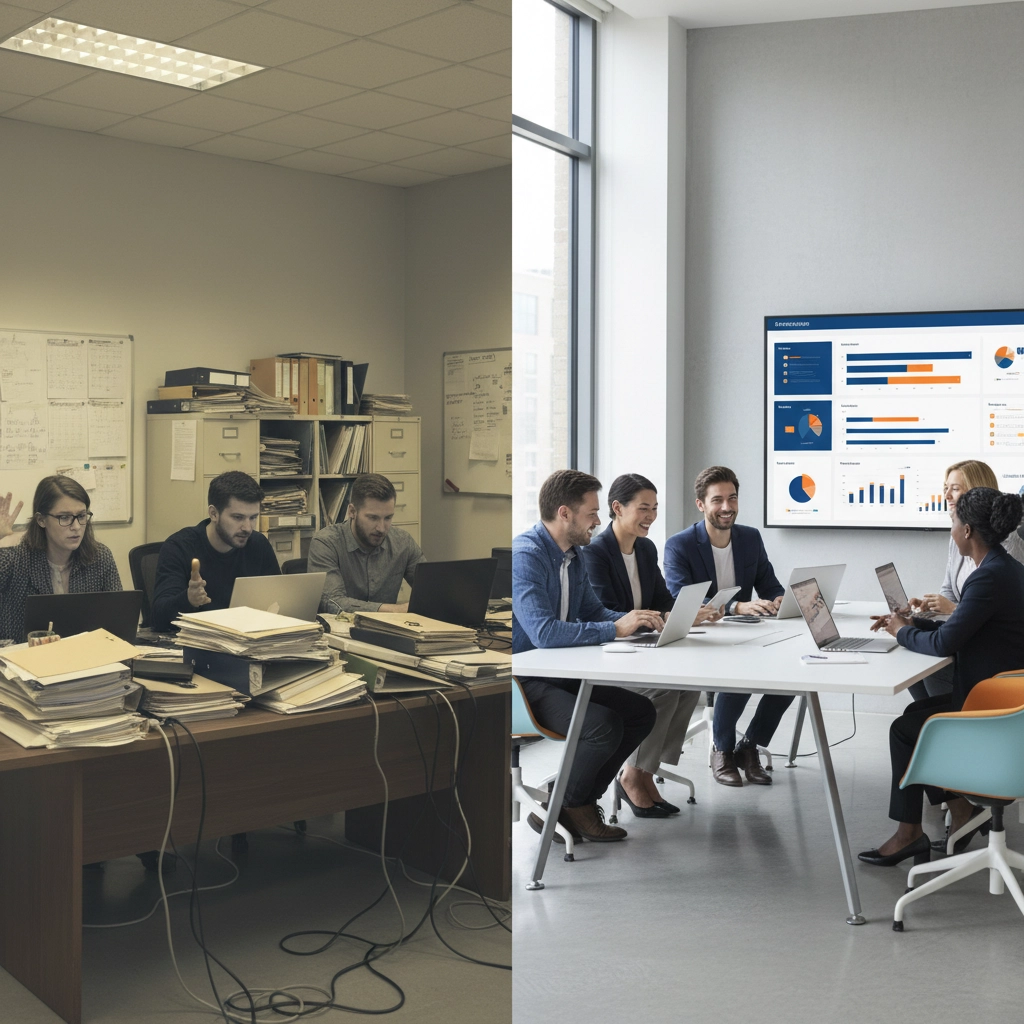
The fundamental problem is that traditional methods were designed for stable, predictable business environments that no longer exist. Modern companies face digital transformations, infrastructure investments, regulatory shifts, sustainability imperatives, and competition from agile startups: all demanding rapid adaptation and innovation.
Traditional project management, which relies on manual processes, creates several critical issues:
- Limited visibility into project progress and resource allocation
- Slow response times to changing requirements
- Duplicate work and communication gaps
- Inefficient resource management
- Poor collaboration between distributed teams
Industry studies demonstrate that over 77% of high-performing projects rely on centralized project management tools, which deliver clear visibility into progress. This contrasts sharply with traditional systems where duplicate work, limited visibility, and slow information updates create significant blind spots.
The Six Essential Principles for Modern Project Management
1. Hybrid Methodologies Over Pure Waterfall or Agile
In 2025, the question is no longer Agile or Waterfall: it is both. Hybrid models are becoming the norm because they reflect reality: different projects require different approaches.
A change initiative might begin with waterfall structure for stakeholder alignment and governance, then transition to agile development for implementation. The key to success is clarity in governance and explicit definitions of when and how each methodology applies.
This approach recognizes that some project phases benefit from structured planning and documentation, while others require iterative development and frequent stakeholder feedback.
2. Real-Time Transparency and Data-Driven Decision-Making
Modern digital project management platforms provide immediate reports on workflow and quality, enabling corrective decisions without delay. This represents a fundamental shift from traditional monthly status reports to continuous monitoring and adjustment.
Real-time transparency includes:
- Live dashboards showing project health metrics
- Automated progress tracking and milestone updates
- Instant visibility into resource allocation and capacity
- Immediate identification of risks and bottlenecks
- Data-driven insights for strategic decision-making
This level of visibility transforms project management from reactive problem-solving to proactive risk management and optimization.
3. Agile Adaptability as a Competitive Advantage

Modern platforms empower managers to respond quickly to shifting priorities while maintaining workflow continuity, effectively transforming change from a challenge into competitive advantage. Rather than viewing changes as failures of planning, modern teams treat them as opportunities.
This requires tools that enable rapid scope adjustments and clear communication protocols. Organizations that can adapt quickly to market changes, customer feedback, or regulatory requirements gain significant competitive advantages over those locked into rigid traditional processes.
Agile adaptability means building change management into project design rather than treating it as an exception that disrupts established plans.
4. Outcome-Focused Management, Not Task Tracking
The shift from measuring hours and task completion to measuring what was achieved, what value was created, and how sustainable the pace is for teams represents a fundamental mindset change.
Project management in 2025 is no longer just scheduling and task tracking: that view is completely obsolete. Project success now depends on delivering strategic business outcomes, not simply adhering to timelines.
Key metrics for outcome-focused management include:
- Business value delivered to customers or stakeholders
- Return on investment and cost-benefit analysis
- Quality measures and customer satisfaction
- Team performance and sustainability indicators
- Strategic alignment with organizational objectives
This approach requires project managers to understand business strategy and connect project deliverables to measurable business results.
5. Strategic PMO Evolution and Collaboration
The traditional view of a Project Management Office (PMO) as an administrative gatekeeping function is changing. Modern PMOs focus on strategic value delivery rather than simply tracking timelines and budgets.
With operational work streamlined through cloud-based tools and automation, PMOs are now free to focus on insights, risk advisory, and enterprise-wide benefits management. This requires deeper collaboration with stakeholders who now have significantly greater understanding of project management and expect greater involvement in decision-making.

Modern PMOs serve as strategic advisors, providing:
- Portfolio optimization and resource allocation guidance
- Risk management and mitigation strategies
- Best practice development and knowledge sharing
- Performance measurement and continuous improvement
- Executive reporting and strategic alignment
This evolution transforms the PMO from a cost center to a strategic value driver within organizations.
6. AI-Powered Automation and Integration
Artificial intelligence, the Internet of Things, and smart machines will play significant roles in project management activities like data collection and analysis. Modern platforms leverage AI automation for mundane tasks, freeing project managers to focus on high-level strategic concerns.
However, AI is not replacing project managers: it is making them significantly more effective. AI capabilities include:
- Automated scheduling and resource optimization
- Predictive analytics for risk identification
- Intelligent reporting and dashboard generation
- Natural language processing for stakeholder communication
- Pattern recognition for process improvement opportunities
Additionally, tools must integrate seamlessly through APIs and AI capabilities rather than operating in isolation. Working with unintegrated, outdated tools that lack API or AI support is fundamentally inefficient in today's environment.
The Strategic Imperative
Organizations can adopt an incremental integration strategy that blends traditional and modern approaches, gradually introducing digital tools and methodologies. The transition from traditional systems is no longer optional: it is essential for competitive survival.
By shifting to digital platforms, organizations achieve faster, more transparent, and more cost-effective project outcomes, giving them a decisive edge in today's demanding business environment.
The bottom line: traditional project management is not dead, but organizations that cling exclusively to legacy methods will find themselves increasingly unable to deliver projects reliably in unpredictable environments. Success in 2025 requires embracing hybrid approaches, digital transformation, AI integration, outcome-focused management, and strategic collaboration: principles that existing traditional methodologies simply were not designed to support.
Ready to modernize your project management approach? Core Project Management Essentials provides comprehensive consulting services to help organizations implement these six principles effectively. Contact us at (877) 633-2763 or visit www.corepmessentials.com to discuss how we can support your transformation. For hands-on training and certification programs, explore our offerings at www.pmteacher.com.
Core Project Management Essentials
5757 W. Century Blvd, 7th Floor, Suite 52A
Los Angeles, CA 90045
Professional Services: www.corepmessentials.com
Training: www.pmteacher.com
If you have trouble remembering your password, you may want to get yourself a copy of “Never Forget” It’s sold on Amazon. https://a.co/d/cLFlvYQ